


Why Dry Wipes? Understanding Their Role in Hospital Hygiene
Dry wipes have largely replaced traditional cotton balls and gauze in modern hospitals. Unlike reusable cloths, single-use dry wipes offer multiple clinical advantages:
- Minimal lint shedding – reduces wound irritation and airborne particles.
- Low allergenic potential – ideal for sensitive patients.
- Standardized size and absorbency – supports consistent procedures.
- Reliable carrier – for sterile water, saline, or disinfectants.
Key applications in hospitals:
- Wound cleaning and dressing
- Patient bed baths
- Instrument pre-cleaning
- Disinfectant delivery
Core message: Recognize dry wipes not as simple cloths but as infection control tools.
Choosing the Right Dry Wipe – Material, Sterility, and Size
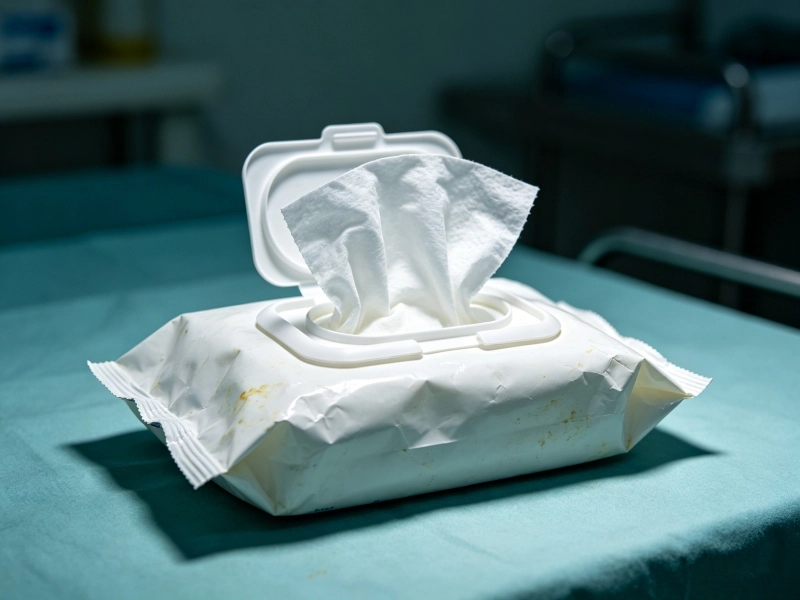
Not all dry wipes perform equally. Selection directly impacts safety and cost.
Material comparison
| Type | Strength | Softness | Best for |
|---|---|---|---|
| Spunlace nonwoven | High | High | Most clinical uses |
| Thermal-bonded | Medium | Low | Light cleaning |
| Wet-laid | Low | Medium | Limited single use |
Recommendation: Spunlace is preferred for most hospital applications.
Sterility requirements
- Sterile dry wipes – mandatory in:
- Operating rooms
- ICUs
- Neonatal units
- Wound care / invasive procedures
- Clean-grade dry wipes – acceptable for:
- Routine environmental cleaning
- General patient care (non-invasive)
Size guidelines
| Size | Use case |
|---|---|
| 10×10 cm | Local wound dressing, small-area cleaning |
| 30×30 cm or larger | Patient bed baths, large-area disinfection |
What to avoid
- Alcohol, latex, fragrances, optical brighteners
- Products without medical-grade certifications
Compliance check: Look for ISO 11137 (sterilization validation) and EN 1644-1 (medical nonwoven standard).
How to Use Dry Wipes Correctly – Clinical Workflows
Correct workflow prevents cross-contamination and ensures efficacy.
Step 1: Storage & handling
- Keep packs sealed between uses.
- Avoid exposing wipes to open air for extended periods (especially sterile packs).
Step 2: Pre-moistening (when needed)
- Use sterile water, saline, or manufacturer-recommended disinfectant.
- Correct method: Fold the dry wipe → saturate → gently press out excess liquid → wipe.
- Never dip a used wipe back into a common solution bottle.
Step 3: Wiping technique
- Wipe in one direction – from clean area to dirty area.
- Use a fresh wipe for each body site or surface.
- Ensure adequate wetness when removing biofilms (mechanical friction is essential).
Step 4: Disposal
- Discard immediately into infectious waste containers.
- Never reuse or rinse dry wipes.
Step 5: Special considerations for disinfectants
- Verify contact time requirements.
- Wipes must remain sufficiently damp throughout the exposure period.
One simple rule: One wipe, one site, one direction, single use.
Infection Control – Avoiding Common Mistakes
Dry wipes can become infection vectors if mishandled. Below are frequent errors and their corrections.
Common mistakes & risks
| Mistake | Consequence |
|---|---|
| Sharing one pack across multiple patients | Cross-transmission of pathogens |
| Leaving pre-moistened wipes in open basins overnight | Bacterial growth (e.g., Pseudomonas aeruginosa) |
| Using the same wipe for different patient zones | Spreading contamination |
| Soaking wipes in improperly diluted disinfectants | Reduced disinfection efficacy |
Best practices for infection control
- Open a fresh pack per patient – or dedicate one pack to a single bed.
- Do not batch pre-wet wipes – prepare just-in-time at point of use.
- Change gloves and wipes when moving between patients.
- Discard any wipe that has fallen on the floor.
Evidence note
Compared to reusable cloths, disposable dry wipes significantly lower cross-contamination rates – supported by CDC and SHEA guidelines.
Training, Auditing, and Cost-Efficiency Strategies
Sustainable implementation requires more than purchasing the right product. Structured training and auditing are essential.
Training recommendations
- Use simulation-based training to demonstrate correct vs. incorrect handling.
- Integrate dry wipe protocols into nursing procedure manuals for:
- Oral care
- Perineal care
- Sterile dressing changes
- Disinfectant preparation
Audit metrics
| Metric | Target |
|---|---|
| Waste rate (wipes per procedure) | ≤ 2–3 wipes per routine task |
| Inappropriate use of sterile wipes | 0% for non-sterile tasks |
| Pre-moistening errors | < 5% of observed occasions |
Cost optimization strategies
- Grade matching: Sterile wipes → invasive procedures only; Clean-grade wipes → general hygiene.
- Pack size selection: Smaller packs reduce post-opening contamination and waste.
- On-ward trials before bulk purchase: Evaluate absorbency speed, linting, and tactile comfort with clinical staff.
Final summary
Dry wipes are neither inherently safe nor unsafe. Their benefits depend entirely on standardized systems – not merely replacing materials. When used correctly, they are powerful allies in hospital infection control.


